Arthur Burbridge
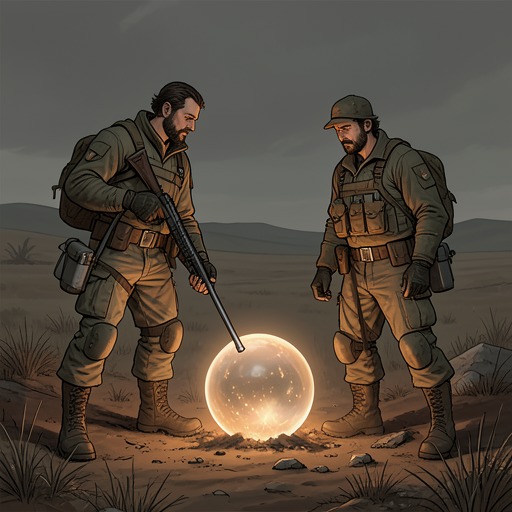
Roadside PicnicArthur Burbridge, also called Artie, is Buzzard Burbridge’s son and Redrick Schuhart’s companion on the perilous journey to the Golden Ball. He reaches the object of the expedition with exuberant faith that he and Redrick have made it, but the same impulsiveness and vulnerability that mark his happiness become fatal in the Zone. His death gives Redrick’s final wish for universal happiness its most immediate human cost: the boy’s remembered joy and the knowledge of his loss occupy the same ending.
Identity and Background
Arthur is presented as the handsome, cherished son of Buzzard and the pride of his parents. Redrick’s recollection emphasizes the difference between the boy and his father and mother: Arthur is their beloved Artie, held up as a family’s treasured child. This domestic image stands in stark contrast to the expedition’s brutal landscape, where people are reduced to their capacity to endure danger and exhaustion.
On the journey, Arthur addresses Redrick as “Mr. Schuhart,” a formality that sets him apart from the older man and makes their unequal positions clear. Redrick is the experienced guide; Arthur is the young companion who depends on his judgment while still bringing his own hopes and excitement to the undertaking. The evidence does not give a fuller account of Arthur’s life before the expedition, but his parents’ pride in him makes the loss more than the death of a fellow traveler: it is the destruction of a family’s cherished future.
The Expedition and Its Promise
Arthur’s immediate objective is bound up with the expedition to the Golden Ball and its promise of wish-granting power. At one point he asks Redrick whether he really believes that the object grants wishes. The question exposes the hope beneath the physical ordeal: the Golden Ball is not merely a destination to reach, but a possible answer to human longing. Redrick dismisses the idea as nonsense, distractedly, and pauses with a cup in his hand. His response offers no reassurance, and the difference between Arthur’s direct question and Redrick’s guarded disbelief leaves the promise unresolved.
The expedition’s outward milestones intensify that uncertainty rather than settling it. Arthur later exclaims that they have made it after all, speaking deliriously and laughing with happiness. He crouches down and beats both fists against the ground, giving his relief a physical, almost celebratory force. His words register the arrival as a victory achieved against the odds; their delirious quality also shows how little that apparent triumph guarantees about what follows.
Redrick and Arthur in the Zone
The relationship between Arthur and Redrick is organized around dependence and responsibility. Arthur calls him Mr. Schuhart, while Redrick’s warning and effort to take on the burden show that he is acting as the more experienced member of the pair. When danger becomes immediate, Redrick tries to bear it himself and shouts for Arthur. The narrative leaves open why Arthur does not respond: he may not hear, may be frightened out of his wits, or may be more severely affected by the heat. That uncertainty matters. His failure to act is not presented as a deliberate rejection of Redrick’s command, but as a breakdown under extreme physical and psychological pressure.
The contrast between Redrick’s effort to withstand the danger and Arthur’s inability to do so marks the limit of the older man’s protection. Redrick would have endured the ordeal and, had Arthur been able to endure it too, they might have passed through with hard effort. Instead, the boy cannot keep pace with the conditions around him. The expedition’s survival depends on recognizing and responding to hazards, but the Zone offers no dependable margin for a delayed warning or a moment of fear.
Death and the Ending
Arthur’s death is the decisive reversal of the expedition’s apparent success. After the boy’s delighted declaration that they have made it, the narrative returns to his parents’ pride in their son and to the place Arthur occupies in Redrick’s memory. The joy of arrival is thus made inseparable from the knowledge that the cherished boy does not return. The passage does not turn his death into a heroic choice: it emerges from the mismatch between Redrick’s attempt to take the danger on himself and Arthur’s inability to respond in time.
At the end, Redrick remembers Arthur walking down, dancing a jig and shuffling to his own beat, white dust rising from his heels as he shouts joyously and festively. The image preserves the boy in motion and celebration, not as a figure defined only by the way he died. Yet Redrick feels a small worm twisting inside him as he watches the remembered scene; the image’s brightness cannot undo the loss. The boy’s song or shout, whose exact nature remains uncertain, carries forward as a sound of unguarded happiness shadowed by what Redrick knows.
Narrative Significance
Arthur’s trajectory turns the expedition’s promise into a measure of its cost. He is a cherished son who imagines that reaching the Golden Ball may mean they have succeeded, but physical arrival does not secure his safety or fulfill the hope attached to the destination. His question about wishes, followed by his ecstatic belief that they have made it, gives the quest a human face; his death exposes the distance between longing and what the Zone permits.
His remembered dance also shapes the moral force of Redrick’s final wish that everyone be happy. The boy’s joy is concrete and particular, rooted in a moment of release after danger, while the wish is vast enough to encompass everyone. The remembered loss makes that appeal neither an abstract slogan nor a simple solution: it is spoken in the presence of a happiness that Redrick recalls vividly but could not preserve for Arthur.